
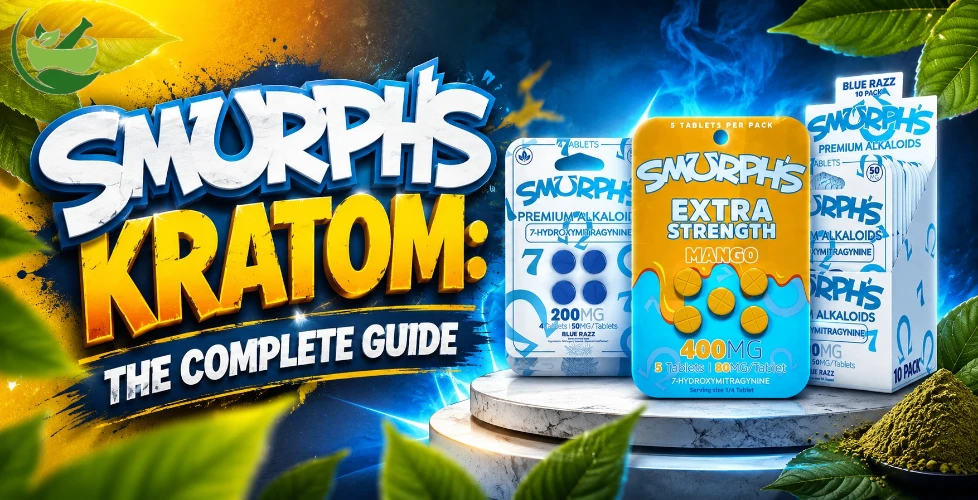
Bright, candy-colored packaging. Flavor names like Blue Razz, Cotton Candy, and Rocket Pop. A wave of enthusiastic reviews calling it “the strongest one I’ve tried.” That’s the world Smurphs Kratom has built for itself inside the fast-growing 7-OH extract market, and it’s why the brand keeps showing up in smoke shops, vape stores, and online kratom retailers across the country.
But Smurphs Kratom isn’t just flavored kratom powder in a tablet. It’s a concentrated 7-hydroxymitragynine (7-OH) extract — a chemically distinct, far more potent product than the whole-leaf kratom most people picture. That distinction changes how it should be understood, used, and evaluated.
This guide covers everything: what Smurphs Kratom actually is, how it’s grown and manufactured, its genuine advantages and its real risks, how it’s typically consumed, the shifting legal landscape around it, and a full FAQ — all laid out honestly, with tables to make the comparisons easy to scan.
What exactly is Smurphs Kratom?
Smurphs Kratom is built from Mitragyna speciosa, a tropical tree native to Southeast Asia whose leaves have been used traditionally for generations, typically chewed fresh or brewed as tea. Traditional kratom products sold in the U.S. — powders, capsules, teas — contain the plant’s full, natural mix of alkaloids, dominated by mitragynine.
Smurphs Kratom is different. Rather than using the whole leaf’s natural alkaloid balance, it’s built around concentrated, extracted 7-OH — a minor alkaloid that makes up only a tiny fraction of raw leaf but is far more potent, gram for gram, at activating opioid receptors than mitragynine is. That’s the single most important fact to understand before anything else: Smurphs Kratom is a refined, potency-focused extract, not “just kratom” in the traditional sense.
Traditional Kratom vs. Smurphs Kratom (7-OH Extract)
| Feature | Traditional Kratom Powder | Smurphs Kratom (7-OH Extract) |
| Primary active alkaloid | Mitragynine | 7-hydroxymitragynine (7-OH) |
| Alkaloid profile | Broad, naturally balanced mix | Isolated, concentrated single alkaloid |
| Opioid receptor activity | Partial, moderate | Strong, more opioid-like |
| Typical format | Loose powder, capsules | Flavored chewable tablets |
| Taste | Bitter, earthy | Masked with candy flavoring |
| Potency per serving | Lower, more variable | High, concentrated in small format |
| Regulatory attention | Long-standing, mixed by state | Rapidly escalating, separate scrutiny |
Production Process: From Leaf to Extract
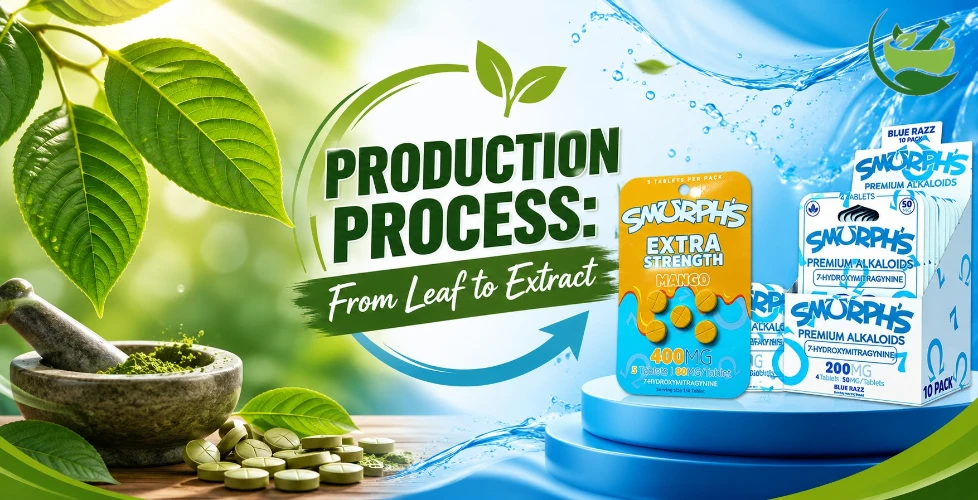
Understanding how Smurphs Kratom tablets are produced explains both its appeal and the concerns around it.
1. Sourcing the raw leaf — Mature kratom leaves are harvested in Southeast Asia, where farms supply the international kratom trade. Sourcing standards vary widely across this largely unregulated supply chain.
2. Drying and grinding — Leaves are dried and ground into powder, still chemically similar to ordinary kratom powder at this stage.
3. Extraction — Solvent-based methods (ethanol, water, or acid/base washes) pull the alkaloids out of the plant material, producing a crude concentrated extract still dominated by mitragynine.
4. Isolation and concentration of 7-OH — Further processing isolates and concentrates 7-OH, often partially converting mitragynine into 7-OH through oxidation, since naturally occurring 7-OH levels in the leaf are far too low to extract directly at commercial scale. This is why researchers often describe isolated 7-OH products as semi-synthetic rather than purely natural.
5. Testing the extract — Ideally, batches are tested for 7-OH concentration before formulation, so manufacturers can calculate how much extract each tablet needs.
Manufacturing Process: How the Tablets Are Made
Smurphs Kratom is manufactured domestically, with production reportedly based in Idaho — a state that has become a hub for kratom and 7-OH extract manufacturing.
| Manufacturing Stage | What Happens |
| Formulation | Concentrated extract is blended with fillers/binders (microcrystalline cellulose, dicalcium phosphate, silicon dioxide, magnesium stearate) to hit a target potency |
| Mixing & granulation | Ingredients are blended into a uniform powder so potency is distributed evenly |
| Flavoring & coloring | Food-grade flavor oils and colorants are added, masking kratom’s natural bitterness |
| Tablet compression | Pharmaceutical-style tablet presses compress the mixture into scored, splittable tablets |
| Packaging | Finished tablets go into blister cards or jars, labeled with potency and warnings, then shipped to retailers |
This entire process happens largely outside FDA oversight. Kratom and 7-OH products are sold as supplements or novelty items, with no mandatory federal standard for manufacturing consistency or labeling accuracy. Smurphs Kratom has addressed part of this gap by publishing third-party lab results for many products — a positive step, though as covered below, that same testing has revealed real inconsistencies.
How Smurphs Kratom Is Typically Used
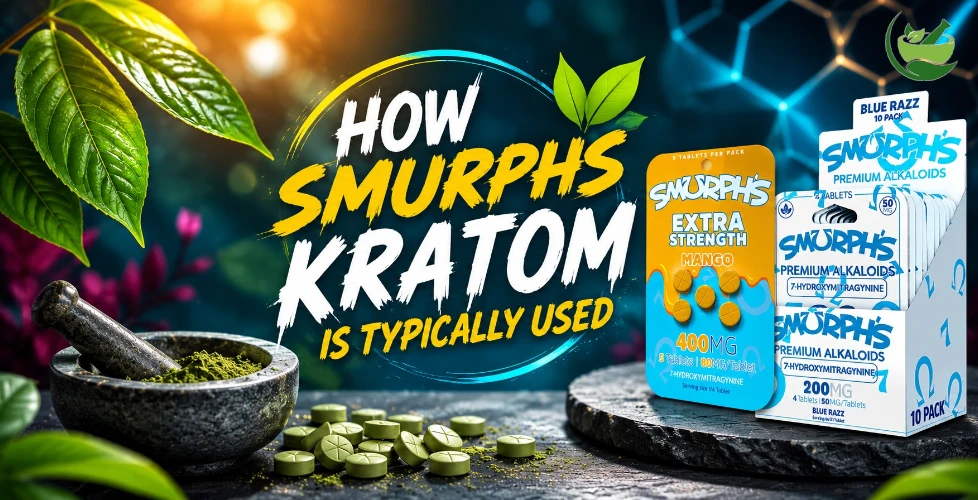
This section describes the product’s format honestly — not as a dosing guide, since I’m not going to provide specific dose amounts, escalation steps, or timing recommendations for a concentrated opioid-receptor-active extract like this one.
| Format Detail | Description |
| Delivery method | Chewable tablet, taken orally |
| Preparation needed | None — no mixing, water, or measuring required |
| Splitting | Many tablets are scored so users can break them into smaller portions |
| Available strengths | Commonly sold as 25mg, 50mg, 60mg, and 80mg tablets (per manufacturer labeling) |
| Flavors | Strawberry, Watermelon, Blue Razz, Cotton Candy, Mixed Berry, Black Cherry, Rocket Pop, Kiwi Dragon Berry, Fuji Apple, Natural |
If you’re considering using Smurphs Kratom, the responsible approach is the same one that applies to any substance with real physiological effects: talk to a doctor first, especially if you have a health condition, are pregnant or nursing, or take other medications; understand that potency labeling for this brand has been inconsistent (see below), so any given tablet may be stronger or weaker than stated; and be aware that regular use of concentrated 7-OH carries a real risk of tolerance and dependency. I’d rather point you toward a healthcare provider for guidance specific to you than hand out generic dosing steps that can’t account for your health history.
Advantages of Smurphs Kratom
1. A major convenience upgrade. No scooping, measuring, or mixing — just a pre-formed tablet.
2. It solves kratom’s taste problem. The wide flavor lineup directly addresses raw kratom’s bitter, earthy taste, a longstanding complaint among users of traditional powder.
3. Portability and discretion. Tablets can be carried and used almost anywhere without preparation.
4. Consistency within a batch — in theory. Scored, standardized tablets are designed to offer more repeatable serving sizes than loose powder, though real-world testing has shown limits to this (see disadvantages).
5. High potency in a small format. A single small tablet can deliver effects that would require far more traditional powder, which is the primary draw for users seeking strong, fast-acting effects.
6. Voluntary lab transparency. Third-party testing results are published for many products — not universal in this industry, and a genuinely good practice.
7. Established brand presence. Recognizable packaging and a wide retailer footprint give buyers more information to go on than an unknown, newer competitor.
Disadvantages and Risks of Smurphs Kratom
1. 7-OH behaves much more like a classic opioid. It’s a stronger, more direct activator of opioid receptors than mitragynine — the core reason for both its potency and its elevated dependency risk.
2. Rapidly escalating regulatory scrutiny. The FDA has raised specific concerns about isolated 7-OH products, and multiple states have banned 7-OH extracts outright even where traditional kratom remains legal.
3. Documented labeling accuracy problems. Independent testing has found Smurphs Kratom tablets running 17–30% below their labeled 7-OH content across multiple flavors and batches.
4. Limited long-term safety data. Most existing kratom safety research covers whole-leaf products, not isolated, concentrated 7-OH extracts.
5. No FDA approval or oversight. These products have not been evaluated by the FDA for safety or efficacy.
6. Real dependency risk with regular use. Tolerance can build over time, and stopping after regular use can involve withdrawal-type symptoms.
7. Batch-to-batch quality variation. Inconsistency has shown up across multiple flavors and testing dates, pointing to a broader manufacturing quality-control issue.
8. Shrinking, shifting access. Retailers already restrict shipping to a growing list of states and counties as regulation tightens.
Advantages vs. Disadvantages at a Glance
| Advantages | Disadvantages |
| Convenient, no preparation needed | Behaves like a stronger, more opioid-like substance |
| Masks kratom’s bitter taste | Facing rapidly increasing state and federal restriction |
| Portable and discreet | Lab testing shows real potency-label mismatches |
| Designed for dose consistency | Long-term safety data is limited |
| High potency in small format | No FDA approval or oversight |
| Third-party lab testing published | Real risk of tolerance and dependency |
| Recognizable, established brand | Batch quality has varied |
| — | Legal access is shrinking in some areas |
The Legal Landscape
Kratom itself is not federally scheduled in the U.S., which has allowed the broader market — including extract brands like Smurphs Kratom — to operate largely unregulated. But individual states differ sharply: some ban kratom outright, and a growing number specifically target 7-OH extracts for separate restriction even while leaving traditional powder legal. Some counties add further local rules on top of state law. The FDA has also signaled increasing concern about concentrated 7-Hydroxymitragynine specifically. Bottom line: check your current state and local law before buying — this is a fast-moving area, and the trend has been toward tighter restriction, not looser.
Frequently Asked Questions About Smurphs Kratom
Is Smurphs Kratom the same as regular kratom powder? No. Smurphs Kratom is a concentrated 7-OH extract in tablet form, while traditional powder contains the leaf’s full, natural alkaloid mix with only trace 7-OH.
Is Smurphs Kratom legal? It depends on your state and county, and the legal landscape is changing quickly — always verify current local law before buying.
What flavors does Smurphs Kratom come in? Strawberry, Watermelon, Blue Razz, Cotton Candy, Mixed Berry, Black Cherry, Rocket Pop, Kiwi Dragon Berry, Fuji Apple, and a Natural unflavored option.
What potencies are sold? Commonly 25mg, 50mg, 60mg, and 80mg tablets, per manufacturer labeling — though independent testing has found actual content often runs below the labeled amount.
Are the potency claims accurate? Not always. Lab testing has found Smurphs Kratom tablets running 17–30% below labeled potency across several flavors and batches.
Is Smurphs Kratom addictive? Regular use carries a real risk of tolerance and physical dependency, given 7-OH’s strong opioid-receptor activity — one of the central concerns regulators have raised about this product category.
Who makes Smurphs Kratom? It’s manufactured domestically, reportedly out of Idaho, a regional hub for kratom and 7-OH extract production.
Is it third-party tested? Yes, many products have published lab results — a good transparency practice, though those same results have revealed potency inconsistencies.
Can I take it with other medications? Talk to a doctor first, especially if you’re pregnant, nursing, have a health condition, or take other medications — interactions aren’t well studied.
Is it available everywhere in the U.S.? No. Availability and shipping vary by state and county, and restrictions are expanding as regulation increases.
Conclusion
Smurphs Kratom is a genuinely different product than traditional kratom powder — a concentrated 7-OH extract engineered for convenience, flavor, and potency through a deliberate extraction and manufacturing process. Its appeal is real: better taste, easier use, and strong effects in a small tablet, backed by voluntary lab transparency that’s better than much of this industry offers.
But the full picture also includes serious caution flags: 7-OH’s closer resemblance to classic opioids, escalating state and federal restrictions, documented gaps between labeled and actual potency, thin long-term safety data, and a genuine risk of tolerance and dependency with regular use.
If you’re weighing whether to try Smurphs Kratom, treat it like any substance with real physiological effects — verify your local law, talk to a doctor, and go in with the full picture rather than just the flavor names on the label.